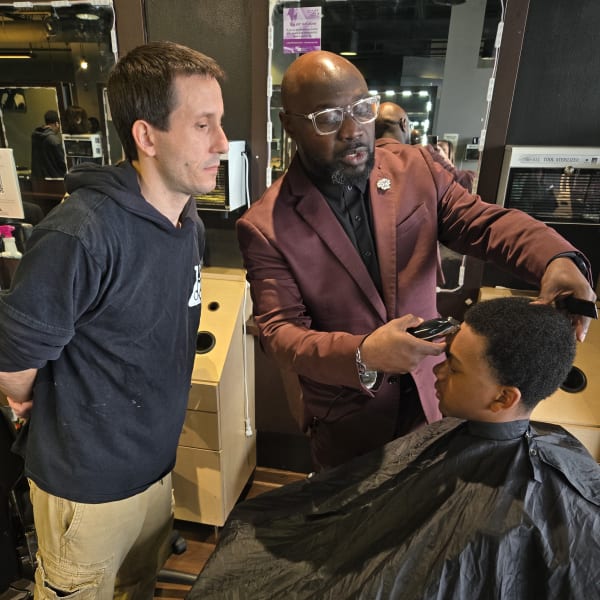
In decades past, specialized male salons or barbershops were the only place for men to receive hairdressing services with masculine finishes, say the educators for Pivot Point International. Now, most salons cater to both women and men, requiring all hairdressers to be able to provide salon services to the male clientele.
And, there are major perks with this bunch: Male clients are known to be the most loyal, having a much higher frequency of visit, male clients are also more than likely to take your retail recommendations, and, once they’ve found their stylist, they are incredibly faithful.
Ad Loading...
Pivot Point’s Meta:Men, Classics Session I, is designed to expand or perfect stylists’ range of techniques geared toward the male client—with a goal of winning new clients and gaining the unending loyalty of current ones.
After introductions, Allison Barker and Jason Russell, field educators, begin the workshop by establishing the characteristics that make a classic male style. In general, men’s styling requires less volume—however, if volume needs to be created, it needs to be strategically placed to support a lean, square silhouette instead of softening. Classic male styles are overall square silhouettes, lean, often tapered, exteriors, tight shapes along the crest, angular shapes in the interior, exposed and defined hairlines and sideburns, and little to no volume.
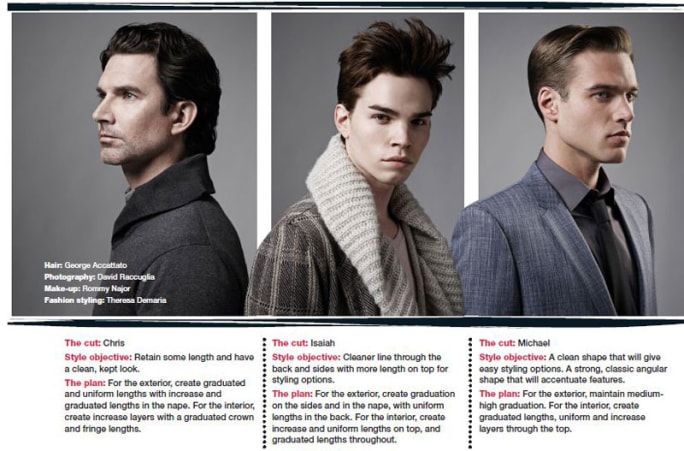
These three looks were recreated by the students at the Meta:Men workshop.
Students learn that while the desired shape of a male hair style resembles a rectangle, the actual head shape of the client is rounded. The cut must compensate by incorporating longer and shorter shapes in the appropriate areas.
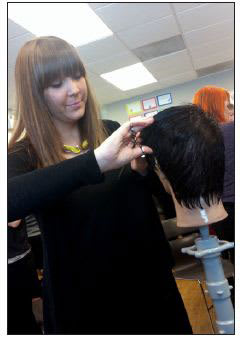
Students are given a male mannequin with long, unkempt hair—before cutting begins, educators review the “7 Sculpting Procedures”: Sectioning; head position (upright, forward, tilted); partings(horizontal, vertical, diagonal); distribution (natural fall, perpendicular, shifted); projection(0-, 45-, 90-degrees); finger/shear position (parallel, non-parallel); and design line (mobile, stationary).
“Holding your shears in an ergonomically correct way will determine if you’re going to be in the industry for four years or 40 years,” educator Barker says.
Ad Loading...
Beginning with the “Chris” finish, students now begin cutting—following a video demonstration of the cut, the educator walks students through a hands-on step-by-step. As students progress to the last cut of the day, “Michael,” educators continue to provide insight into the male client and how to achieve the best results.
“Horizontal partings add weight, so when cross checking a men’s hair cut, don’t cut too much or it will add weight,” educator Russell says.
“If needed, go back in vertically or notch horizontally if your lengths are inconsistent.”
Alison’s Overview
“The Meta:Men advanced education workshop was very important for me to participate in because I didn’t have confidence in my men’s cutting skills. Not only did we learn hair cuts and techniques, but we also learned what defines a men’s hair cut—the characteristics that differentiate women’s cuts and shapes with men’s silhouettes.
By the end of the workshop, educators Jason Russell and Allison Barker had helped the class earn that confidence to feel ready to embrace all the perks that come with having a male clientele. Along with a certificate of completion, we were also given the Meta:Men DVD to review each cut and technique learned in the class.”
Anny VanDriel, owner of Be Rosie Salon and creator of Pricing Isn’t Personal, volunteered to share a pricing presentation to beauty school students a year ago, and ended up learning more than she expected.
From the launch of the Ulta BeautyArtist Collective to the evolution of Trendspiration, celebrating stylists is what The Salon at Ulta Beauty does best.
With more than four decades in the industry, hairdresser and MODE Education founder Stan Newton has built a career around the art and discipline of cutting hair, learning the rules so he can break them.
Beauty professionals should evaluate each service based on its popularity, profitability, and alignment with current trends. Conducting client surveys and analyzing booking data can provide insights into which services are in demand and which might be phased out.
LifeSpa leader Ali Yanez explains why strong mentorship, predictable income, meaningful recognition and the right work environment help beauty professionals build careers that last.
Whether a beauty professional chooses a commission salon, booth rental, salon suite or salon ownership, the common thread is having more choices than ever before.
Sport Clips Haircuts will host its inaugural "Level Up Live," a first-of-its-kind virtual event that combines live haircutting education, career inspiration, product knowledge, and employment opportunities for licensed stylists and cosmetology students nationwide.
Orthopedic PT reveals three daily exercises plus ergonomic advice that can help salon professionals avoid the aches and injuries caused by standing, bending and repetitive overhead work.
Salon suite pioneer Karen Kaminski argues that the next evolution of independent beauty businesses won't be defined by beautiful spaces alone, it will be driven by smarter systems that help professionals spend less time on administrative work and more time serving clients.
At a time when many LGBTQ+ people felt compelled to hide parts of themselves, Carlos Valenzuela found a career in beauty and a community that offered opportunity based on what you could do and how well you could do it.
Whether it's social media, fashion, film, art, or culture, Chaz Dean advises stylists to stay aware of what's inspiring people. Take the elements that make sense for you in these five lessons learned through a life in beauty.
For Jessica Domoney, building a successful career isn't about saying yes to every opportunity, it's about protecting your time, investing in yourself and creating an experience clients won't forget.
"The mistake people make is treating AI like a vending machine instead of a personal assistant." Digital marketing expert Scott Moon shares how beauty professionals can use AI while staying authentic
Real-world advice on creativity, consultations, color, burnout, business, boundaries, inclusivity, client care, and career growth from educators and industry experts.
Real-world advice on creativity, consultations, color, burnout, business, boundaries, inclusivity, client care, and career growth from educators and industry experts.