Be Your Guests' First Line of Defense Against Skin Cancer
Beauty professionals can be the first line of defense for guests and themselves in the prevention and detection of skin cancer. A MODERN SALON editor shares her own story.
It wasn't the diagnosis I was expecting as a healthy 26 year old. After hanging up the phone in a total state of shock, the doctor's words sunk into my brain: skin cancer, oncologist, melanoma. All I could do was cry. I cried when I told my boyfriend. I cried when I told my mom. I cried when the oncologist and surgeon both told me the margins needed to make sure all the cancer was removed meant amputating that entire part of my extremity.
In the past, stress and anxiety have hit me from external factors like work, relationships or school. They had never come out of something internal and so out of my control. I learned quickly when your own health is at risk, those aforementioned factors take a back seat. My brain switched to autopilot; all that mattered is I stopped the cancer and did what was best for my body.
Ad Loading...
WHAT TO LOOK FOR
According to Dermatologist Dr. Dendy Engelman, melanoma is one of the three most common types of skin cancer: Basal cell carcinoma is the most common by far, followed by squamous cell carcinoma, and then malignant melanoma.
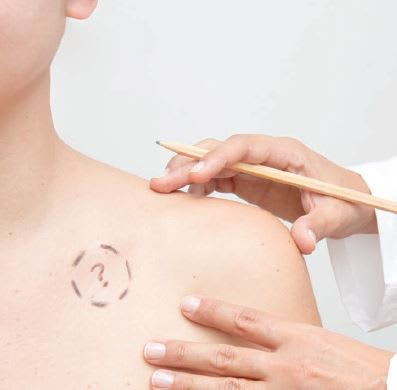
When I have told people my story, the question I have gotten most frequently has been: how did you know to go to your dermatologist and have it checked? Over the course of a couple years, I had watched a freckle appear out of nowhere, then change pretty rapidly. By the time I went to the dermatologist, it was no bigger than the tip of a blunt pencil, but the shape was asymmetrical and the borders weren’t defined. Upon doing my own research, there were several signs that something might be off.
According to the Skin Cancer Foundation, an atypical mole can be detected with the ABCDE warning signs:
A is for Asymmetry. Most melanomas are asymmetrical. If you draw a line through the middle of the lesion, the two halves don’t match.
B is for Border. Borders tend to be uneven and may have scalloped or notched edges, while common moles tend to have more smoother, more even borders.
Ad Loading...
C is for Color. Multiple colors are a warning sign. While benign moles are usually a single shade of brown, a melanoma may have different shades of brown, tan or black. Red, white or blue may also appear.
D is for Diameter and Dark. While it’s ideal to detect a melanoma when it’s small, it is a warning sign if a lesion is the size of a pencil eraser or larger. Some experts say it is also important to look for any lesion, no matter what size, that is darker than others.
E is for Evolving. Any change in size, shape, color or elevation of a spot on your skin, or any new symptom in it, such as bleeding, itching or crusting, may be a warning sign to see your doctor.
YOU ARE THE FIRST LINE OF DEFENSE
Luckily in my situation, I had noticed the spot appear and evolve, and was consistently monitoring the changes. In many scenarios, though, skin cancer will show up in places not visible to its host: on the scalp, behind ears, or between fingers and toes. But for a guest who regularly sits in your chair, these are areas of the body you do see all the time—whether it is sectioning the hair during a cut or color, or during a skin treatment, manicure or pedicure.
“Beauty professionals have the unique ability to point out something out of the ordinary that a patient might not know to bring up to the dermatologist,” Dr. Engelman says. “They should educate themselves on the types of abnormalities to look for and always direct their client to a care physician.”
Ad Loading...
If you notice something abnormal on your client, gently bring it to their attention. There are a number of skin lesions—both benign and cancerous—that occur on the scalp. So just because there is a scalp lesion, doesn’t mean that it’s dangerous, but it should certainly be examined.
“I recommend just pointing out the lesion of concern and asking if they were aware of it,” Dr. Engelman says. “If so, ask if it has been checked by a dermatologist. If yes, great! That’s all that needs to be done. If not, encourage them to get it checked to ensure it’s nothing dangerous.”
PREVENTION FOR YOU AND YOUR CLIENT
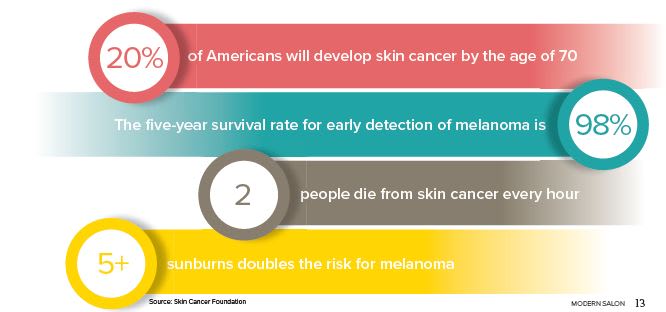
Skin cancer is treatable if stopped in the early stages. Undiagnosed skin cancer allows the cells to grow out of control and in some cases make the cancer untreatable and life-threatening. It is important to monitor your and your clients’ skin changes.
For both the stylist and the client, the most important thing is to protect against sun damage—both UVA and UBA rays.
“This means SPF daily, year-round, protective clothing, and limiting sun exposure, especially at peak times, from 10 a.m. to 4 p.m.,” Dr. Engelman says. “You need at least SPF 50 if planning to be active outside. The American Academy of Dermatology’s guidelines state that a minimum of SPF 30 is required.”
Ad Loading...
After my surgery, I was told my margins were clear—the best news anyone with skin cancer could hear. Sun protection, annual body scans at the dermatologist, and self exams are going to be important elements I will carry through the rest of my life.
May is national skin cancer awareness month. Whether on you or your client, the most important takeaway to remember is: when in doubt, check it out. I am so thankful I did.
The FutureIQ™ biomimetic hair longevity serum is a lightweight, fast-absorbing formula, powered by K18’s proprietary MultiVital™ technology, designed to simultaneously support hair retention, scalp vitality, and pigment longevity through biology-first intervention.
Thanks! Naturals product lineup includes fizzing bath soaks and glow butters to roll-ons, balms, and body and hair mists, and each product delivers an instant sensory boost
In this content series, we're focusing on artists who found a niche that really speaks to them and work for their career. Henry "Tribes" Amoloja (@theweightedcape), is based in Dallas, TX, and practices sensory-friendly barbering.
YouGov report explores anti-aging attitudes, skincare routines, Botox awareness, and how prevention-minded consumers are shaping the beauty and wellness market.
The Paul Labrecque Salon salon is finding success --for stylists and clients, alike--offering scalp care and specialized treatments. MODERN spoke to Moine about how this focus meets an important need and drives client loyalty.
Hair loss is a concern that nearly everyone encounters personally or through someone they care about. Understanding the different types of hair loss and the available treatment options can help individuals make informed decisions about their next steps.
As we enter 2026, surveys show health and wellness at the top of New Year’s resolutions globally, again. Based on Google Trends analytics, clinicians highlight the biggest health and wellness trends for 2026, from rising interest in electric medicine to the threats of extreme diets.
For salons and stylists ready to tackle hair-thinning, understanding the why, building the right network of partners, and offering scalp-focused services will be key.