






Why Salon Work Makes Your Body Ache & What You Can Do to Feel Better
We learn some simple moves and strategies to keep the blood pumping through the muscles and limit posture problems from The Balanced Beauty Pro
by Anne Moratto
 MENU
MENU SEARCH
“When your feet are miserable, you’re miserable!” says stylist Michael Breen, owner of Michael’s Cottage Salon in Jacksonville, Florida. Being on your feet all day isn’t good for the human body, but that’s how ...

Getty Images
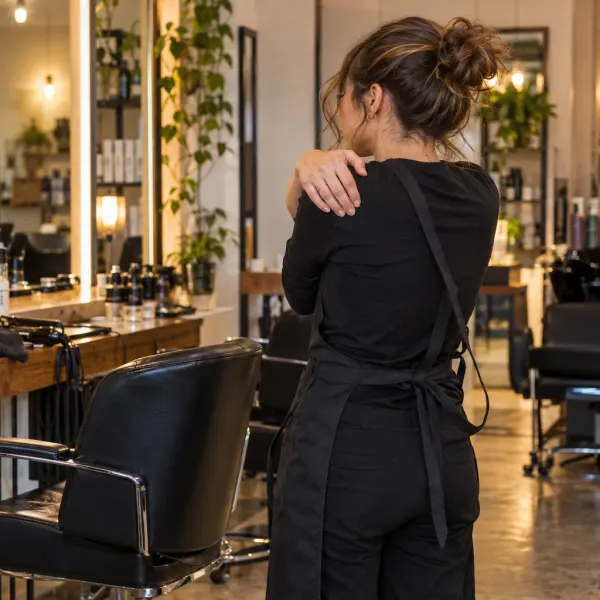
“When your feet are miserable, you’re miserable!” says stylist Michael Breen, owner of Michael’s Cottage Salon in Jacksonville, Florida. Being on your feet all day isn’t good for the human body, but that’s how hairdressers make a living. Although it’s no longer unusual to see a salon dotted with stools so that stylists can sit while cutting, standing will always have a foothold in this career.
According to the National Institutes of Health (NIH), a recent study indicated that standing five hours a day not only contributes to short-term pain and discomfort but also raises the risk for long-term back pain and musculoskeletal disorders. The study’s lead author, Maria-Gabriela Garcia, a doctoral candidate at ETH Zurich in Switzerland, told NIH that stretching exercises, regular breaks and alternating standing with some seated work might alleviate the effects of long-term fatigue.
“The body does not like to have the same posture or load placed on it continuously, so change is always good,” Kermit Davis, graduate program director for environmental and occupational hygiene at the University of Cincinnati, explains on the NIH website. “Routine breaks get the blood moving.” Davis advises taking a break every 30 minutes. That’s easier said than done for most hairdressers.
Another strategy stylists try is using shoe inserts—or going the more expensive route toward custom orthotics. The American Podiatric Medical Association (APMA) recommends shoe inserts to support flat arches as well as to relieve general foot and leg pain. But simple shoe inserts might not solve problems caused by serious conditions such as diabetes or poor circulation, APMA cautions.
APMA lists the most common types of inserts: arch supports, designed to support the foot’s natural arch; insoles made of gel, foam or plastic to provide extra cushioning and support; heel liners to ease heel pain; and foot cushions to prevent the heel or toes from rubbing against the shoe. When you select a shoe insert, APMA suggests:
Think about the purpose. An insert that supports long periods of standing might not be the same one you’ll need for marathon training.
If you can, try them on. This just makes sense!If it’s not possible because of the packaging, ask about the store’s return policy, and keep the receipt.
Bring your shoes. Having the shoe that you intend to use with the insert will help you select a good match for the size and shape.
Orthotics are widely regarded as helpful even though scientists haven’t figured out exactly how they work, according to NIH. This makes it difficult to determine the best orthotic design for any individual foot. Still, many patients find relief. Breen has been using orthotics for nearly 20 years. When his podiatrist found that the nerve endings in Breen’s toes had expanded to the size of grapes and his shoe size ballooned from an 8 to a 10, the stylist went to a Foot Solutions store to explore the idea of orthotics.
“At Foot Solutions, they design an arch for you,” Breen says. “It puts your balance back on your heels.” Although that targeted some of his pain, it was just the beginning of Breen’s career-related leg and foot problems. Even though he stood on a cushioned mat, he began to notice varicose veins on his front shins.
“Florida is the land of shorts,” Breen says. “Nobody likes the way varicose veins look!” And nobody likes the pain caused by pressure from these veins. Breen tried various brands of compression socks, but it wasn’t until he found Stand + Deliver, compression hosiery developed specifically for hairdressers, and a Healthy Hairdresser sponsor, that he noticed a significant difference.
“Stand + Deliver doesn’t make men’s sizes, so I bought the largest women’s size,” Breen says. “What I like the best is that the toe area is looser, so you’re not compressing the toes like the socks I tried in the past. The support comes from the ankles up, and my legs are not as tired at the end of the working day.”
With 40 years in the industry, Staycee Margart still puts in 10-hour days three times a week. She’s been careful throughout her long career to take care of her health.
“I stand on a mat and also use a stool,” says Margart, owner of Toppers in Sebastopol, California. “I maintain a good diet, practice yoga and don’t smoke. A podiatrist recommended that I wear support hose, and I thought, ‘I’m not going to do that.’ But I saw an ad for the Stand + Deliver socks, so I bought a pair. I plan to buy more when winter comes.”
Margart says switching among different shoes has helped her keep happy feet. “I alternate Danskos, Naots, Birkenstocks and tennis shoes,” she says. “For me, health has always been a passion. That’s why I got into the beauty industry—beauty and health are so closely related.”
We learn some simple moves and strategies to keep the blood pumping through the muscles and limit posture problems from The Balanced Beauty Pro

Anny VanDriel, owner of Be Rosie Salon and creator of Pricing Isn’t Personal, volunteered to share a pricing presentation to beauty school students a year ago, and ended up learning more than she expected.

From the launch of the Ulta BeautyArtist Collective to the evolution of Trendspiration, celebrating stylists is what The Salon at Ulta Beauty does best.
Sponsored by Ulta Beauty

With more than four decades in the industry, hairdresser and MODE Education founder Stan Newton has built a career around the art and discipline of cutting hair, learning the rules so he can break them.
Beauty professionals should evaluate each service based on its popularity, profitability, and alignment with current trends. Conducting client surveys and analyzing booking data can provide insights into which services are in demand and which might be phased out.

LifeSpa leader Ali Yanez explains why strong mentorship, predictable income, meaningful recognition and the right work environment help beauty professionals build careers that last.

Whether a beauty professional chooses a commission salon, booth rental, salon suite or salon ownership, the common thread is having more choices than ever before.

Sport Clips Haircuts will host its inaugural "Level Up Live," a first-of-its-kind virtual event that combines live haircutting education, career inspiration, product knowledge, and employment opportunities for licensed stylists and cosmetology students nationwide.

Orthopedic PT reveals three daily exercises plus ergonomic advice that can help salon professionals avoid the aches and injuries caused by standing, bending and repetitive overhead work.

Four publications for beauty industry professionals to enhance their leadership skills, financial awareness, professional growth, and joy!
Salon suite pioneer Karen Kaminski argues that the next evolution of independent beauty businesses won't be defined by beautiful spaces alone, it will be driven by smarter systems that help professionals spend less time on administrative work and more time serving clients.

At a time when many LGBTQ+ people felt compelled to hide parts of themselves, Carlos Valenzuela found a career in beauty and a community that offered opportunity based on what you could do and how well you could do it.

Whether it's social media, fashion, film, art, or culture, Chaz Dean advises stylists to stay aware of what's inspiring people. Take the elements that make sense for you in these five lessons learned through a life in beauty.

For Jessica Domoney, building a successful career isn't about saying yes to every opportunity, it's about protecting your time, investing in yourself and creating an experience clients won't forget.
MODERN SALON sat down with Samuels to discuss the book, beauty education, mentorship and the habits that help beauty professionals thrive.

"The mistake people make is treating AI like a vending machine instead of a personal assistant." Digital marketing expert Scott Moon shares how beauty professionals can use AI while staying authentic

Real-world advice on creativity, consultations, color, burnout, business, boundaries, inclusivity, client care, and career growth from educators and industry experts.