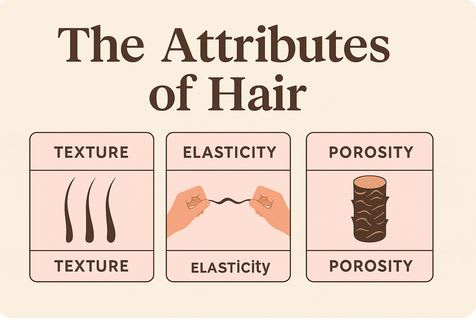
As a professional, you likely perform a spontaneous assessment of your client’s hair quality without ever realizing it. Even so, having a good grasp of the key attributes of hair and the scientific terminology to accurately describe it, goes a long way. This article rounds up the fundamental attributes of hair and some popular tricks to quickly assess each.
Hair Science 101
The first one is texture.
Texture quite simply indicates the thickness of each hair strand. It is classified as coarse, medium or fine with coarse being the thickest and fine being the thinnest. Generally speaking, coarse hair is stronger or more resistant and requires hair services to be intensified accordingly. On the other hand, fine hair is more fragile and requires gentler treatment. Medium hair is in between and fares well with a nominal approach. The best way to estimate texture is to separate out a single strand of hair and feel it between the thumb and index finger to assess the thickness. With a little practice, you can quickly identify texture using this method. Fine hair does not hold styles very well whereas coarse hair does although it takes longer to style. Remember that texture can vary from one area of the scalp to another on the same head.
The second one, elasticity, means just that - ability of the hair strand to stretch without breaking.
Elasticity can be either high, medium or low. Healthy hair exhibits a good amount of elasticity and can be stretched well beyond its original length. The strands just snap back to the original length when released as opposed to hair with low elasticity which would just break. Wet hair stretches more than dry hair and it is therefore recommended to test elasticity on wet hair. Elasticity can be easily checked by holding each end of a hair strand in one hand and gently pulling them apart. The strands' behavior on releasing the tension will immediately give you an idea of its elasticity.
The third attribute is porosity.
Just like elasticity, porosity is also classified as high, medium or low. Porosity is most directly correlated to chemical overprocessing or harsh heat treatment. Stated a different way, hair that has been subjected to adverse conditions is high in porosity and should be treated with extra care whereas healthy hair is low in porosity and inherently stronger. High porosity means the cuticle of hair is lifted and damaged while low porosity suggests that the cuticle layer is compact and lays flat. Medium porosity hair belongs to neither extreme and is the most common type. Highly porous hair has the ability to absorb and retain more easily than the other variants. To assess porosity of hair, grab a small lock of hair and run your index and thumb fingers against the grain (from the ends toward the scalp) while holding the end pinched with your other hand. Healthy hair with low porosity should feel smooth and once you have done this a few times, the roughness of high porosity hair can be easily noticed. Hair with high porosity needs milder treatment and certain services might be best avoided to prevent irreversible damage.
Density, or the number of hair strands per square centimeter of the scalp, is also an important attribute to be aware of as you work through the service. While that is the technical definition of hair density, it is often indirectly assessed early on by evaluating the amount of hair or the ‘thickness’ of hair of your client. Knowing the density or amount of hair is useful in estimating how much product or color or time you need to plan for a particular client.
In addition to these aspects, gaining an understanding of the natural pattern of hair growth, curl pattern, oiliness or the lack thereof, scalp health, allergies, etc. for each client helps tailor hair services to them and educating them on the outcome of the hair service. Setting the right expectations and delivering on them directly translate to client satisfaction and an improved experience.
ABOUT THE AUTHOR: Tej Belagodu is a hair enthusiast and entrepreneur. During the Covid19 pandemic, he developed an online marketplace where clients could buy customized DIY hair color kits formulated by licensed stylists based on a video consultation. He is currently exploring a couple of new ideas in the hair industry and evaluating their viability. Occasionally, he writes articles on various topics related to hair. At his day job, he is an Engineering Manager in the manufacturing organization of a semiconductor technology company. He has a Master of Science degree in Electrical Engineering from Arizona State University. Tej can be reached at tej.belagodu@gmail.com.