We're sharing this refresher on the Anatomy of Hair as part of our MODERN SALON 101 series, a focus on the fundamentals. Because no matter how long you’ve been working at your craft, the basics are always worth revisiting.
Editor's Note: At MODERN SALON, we’re celebrating101 yearsof educating and inspiring beauty professionals. As part of this milestone, we’re embracing the concept of "101" courses--those introductory courses in the U.S., where the first level of any subject is often numbered 101 (e.g., "Biology 101" or "Marketing 101"). These courses cover the fundamentals, providing a foundation of essential knowledge before diving into more advanced topics.
In that spirit, we’re sharing this refresher on the Anatomy of Hair written by Tej Belagodu because no matter how long you’ve been working at your craft, the fundamentals are always worth revisiting.
Ad Loading...
HAIR SCIENCE 101: THE ANATOMY OF HAIR
Whether you're a hairstylist, a salon owner, or in a corporate role; if you're a part of the beauty industry, you understand the importance of hair to an individual – the delight of a good hair day, the anxiety of thinning hair, and everything in between. Regardless of your specialty in the hair industry, here's a quick refresher on the anatomy and biological structure of hair.
Hair is primarily composed of a protein called keratin. Long, coiled chains of this protein are linked end-to-end and arranged in a spiral structure called a helix to form hair strands. The elements that make up this protein are carbon, oxygen, nitrogen, hydrogen, and sulfur, in that order. Interestingly, these are the same elements that make up skin and nails.
Broadly, a mature strand of hair is composed of two parts: the hair root, which is below the surface of the skin/scalp, and the hair shaft, which is above it. The follicle generates living cells which transform into protein as they mature and move upwards toward the surface of the skin. As they emerge and become a part of the hair shaft, they are completely keratinized, have lost their nucleus, and are no longer living cells.
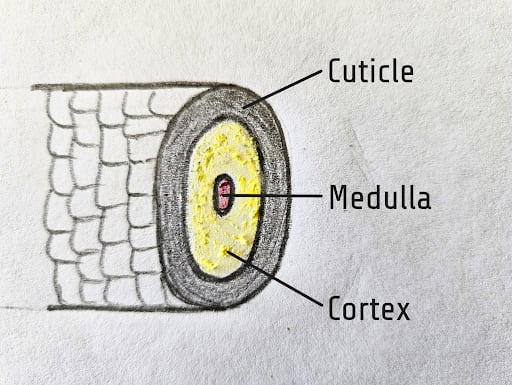
Things get a little more interesting when you look at the cross-section of a strand of hair (Image 1). Each strand is composed of three distinct layers: the medulla (innermost), the cortex (middle), and the cuticle (outer). Their composition, thickness, and characteristics can vary greatly from person to person. The medulla typically does not participate in salon services and is often completely absent in fine hair. The bulk of the weight of hair strands comes from the cortex which can be accessed by lifting the cuticle layer using an alkaline solution. The cuticle has a scaly structure and typically bears most of the brunt of styling, coloring, products, and the elements.
Photo credit: Tej Belagodu
Image 1. Cross-section of a hair strand.
Ad Loading...
Credit: Tej Belagodu
The cuticle arguably plays the biggest role in how your hair looks and feels, and consequently, it is the layer talked about the most. Damaged or unhealthy cuticles lead to a loss of shine, frizz, unmanageable hair, and can even lead to split ends. A variety of reasons can cause harm to cuticles, but the most common ones are harsh chemical treatments, frequent use of hot tools, and mechanical stress to hair (think vigorous brushing, tight ponytails, etc.). Damaged cuticles can be nursed back to good health, however. Moisturizing and conditioning, gentle sulfate-free hair care products, heat protection, scalp massages, and periodic hair masks can all help. Additionally, a vital tip that works wonders on the cuticle is to do a cold rinse at the end of a hair wash. The cold water makes cuticles lay down flat, giving hair shine as well as preventing moisture and dust from entering the shaft (Image 2).
Image 2. Electron microscope image of the author’s hair strand. The scaly surface is the cuticle.
Credit: Tej Belagodu
As for the cortex and medulla, a balanced diet with healthy proteins and the right amounts of micronutrients like vitamins A, C, D, and E, amino acids, biotin, and omega-3 fatty acids go a long way. Good practices suggested here previously, like avoiding harsh chemicals, minimal heat styling, and scalp massages, help promote healthy cortex and medulla layers as well. Additionally, regular trims are highly recommended to keep hair pruned and growing healthily. Trims help prevent split ends, or at a minimum, prevent them from going deeper into the hair shaft and compromising the integrity of the inner layers.
Ad Loading...
So there! That's the biology of hair in a nutshell, along with simple tips to keep your hair healthy.
ABOUT THE AUTHOR: Tej Belagodu is a hair enthusiast and entrepreneur. During the Covid19 pandemic, he developed an online marketplace where clients could buy customized DIY hair color kits formulated by licensed stylists based on a video consultation. He is currently exploring a couple of new ideas in the hair industry and evaluating their viability. Occasionally, he writes articles on various topics related to hair. At his day job, he is an Engineering Manager in the manufacturing organization of a semiconductor technology company. He has a Master of Science degree in Electrical Engineering from Arizona State University. Tej can be reached at tej.belagodu@gmail.com.
Anny VanDriel, owner of Be Rosie Salon and creator of Pricing Isn’t Personal, volunteered to share a pricing presentation to beauty school students a year ago, and ended up learning more than she expected.
From the launch of the Ulta BeautyArtist Collective to the evolution of Trendspiration, celebrating stylists is what The Salon at Ulta Beauty does best.
With more than four decades in the industry, hairdresser and MODE Education founder Stan Newton has built a career around the art and discipline of cutting hair, learning the rules so he can break them.
Beauty professionals should evaluate each service based on its popularity, profitability, and alignment with current trends. Conducting client surveys and analyzing booking data can provide insights into which services are in demand and which might be phased out.
LifeSpa leader Ali Yanez explains why strong mentorship, predictable income, meaningful recognition and the right work environment help beauty professionals build careers that last.
Whether a beauty professional chooses a commission salon, booth rental, salon suite or salon ownership, the common thread is having more choices than ever before.
Sport Clips Haircuts will host its inaugural "Level Up Live," a first-of-its-kind virtual event that combines live haircutting education, career inspiration, product knowledge, and employment opportunities for licensed stylists and cosmetology students nationwide.
Orthopedic PT reveals three daily exercises plus ergonomic advice that can help salon professionals avoid the aches and injuries caused by standing, bending and repetitive overhead work.
Salon suite pioneer Karen Kaminski argues that the next evolution of independent beauty businesses won't be defined by beautiful spaces alone, it will be driven by smarter systems that help professionals spend less time on administrative work and more time serving clients.
At a time when many LGBTQ+ people felt compelled to hide parts of themselves, Carlos Valenzuela found a career in beauty and a community that offered opportunity based on what you could do and how well you could do it.
Whether it's social media, fashion, film, art, or culture, Chaz Dean advises stylists to stay aware of what's inspiring people. Take the elements that make sense for you in these five lessons learned through a life in beauty.
For Jessica Domoney, building a successful career isn't about saying yes to every opportunity, it's about protecting your time, investing in yourself and creating an experience clients won't forget.
"The mistake people make is treating AI like a vending machine instead of a personal assistant." Digital marketing expert Scott Moon shares how beauty professionals can use AI while staying authentic
Real-world advice on creativity, consultations, color, burnout, business, boundaries, inclusivity, client care, and career growth from educators and industry experts.
Real-world advice on creativity, consultations, color, burnout, business, boundaries, inclusivity, client care, and career growth from educators and industry experts.