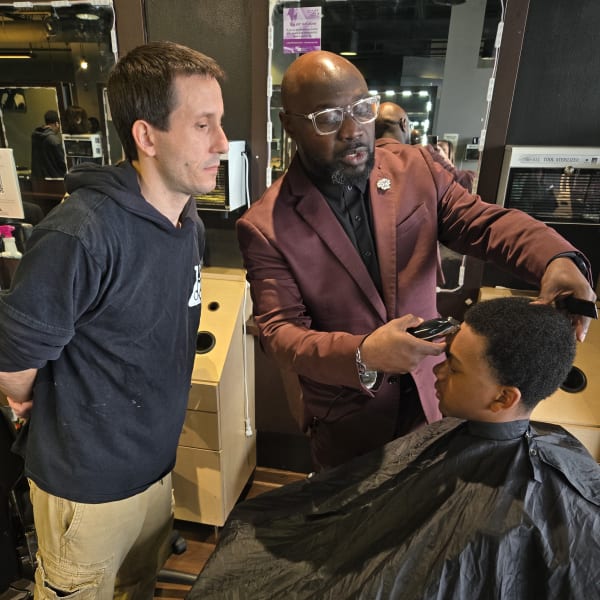
Rodrick Samuels on The Silent Work, Modern Beauty Education and Why Empathy Wins
MODERN SALON sat down with Samuels to discuss the book, beauty education, mentorship and the habits that help beauty professionals thrive.
Although survival rates have increased, breast cancer continues to be the most commonly diagnosed cancer in women. There are some healthy steps to lowering your risk.

Panic vs. denial: two likely, polar-opposite reactions when you feel a lump in your breast. The former will launch you into immediate action; the latter, while giving you time to process, can cause a risky delay in treatment.
Ann McGowan, a hairdresser in Providence, Rhode Island, was in her 60s, teaching and managing a cosmetology school as well as doing hair at a nursing home salon. She was busy, and the lump in her breast didn’t quite register.
“One afternoon while I was alone at my nursing home job, a lightbulb went on in my mind,” McGowan recalls. “I called my doctor, and when I went to see him he told me what I expected to hear—that it was cancer. Soon after, I had a mastectomy.”
That was in 1991. Now 93, McGowan still styles hair for some home-bound clients. A lifelong athlete, she was honored at the recent 2017 National Senior Games for being among only eight athletes who have competed in all eight biennial Senior Games. This year she took gold in the javelin throw in her age division.
Like McGowan, many of the 2.8 million U.S. breast cancer survivors now back to living full lives began their cancer journey by discovering a lump on their own. But a lump is not the only sign that you need to see a doctor. The American Cancer Society (ACS) lists six warning signs for breast cancer:
• A painless, hard mass with irregular edges or, in rare instances, a tender, soft, rounded mass.
• Generalized swelling of part of a breast, even with no evidence of a lump.
• Irritation or dimpling on the breast skin.
• Nipple pain or an inward-turning nipple.
• Redness or scaliness of the nipple or breast skin.
• Discharge other than breast milk.
Mammograms help diagnose breast cancer when the tumor is too small for you or your doctor to feel. Today there is controversy surrounding the value of mammograms for average-risk women—average risk referring to women with no personal or strong family history of breast cancer, no genetic mutation such as BRCA and no chest radiation therapy before age 30. Currently, ACS issues these guidelines:
• Age 40-44: optional annual mammogram.
• Age 45-54: recommended annual mammogram.
• Age 55+: woman’s choice whether to continue with annual mammogram or switch to every other year.
Screenings should continue as long as the woman is in good health and expected to live at least another 10 years. Of course, the larger goal is prevention. Being female is your primary risk for breast cancer, although nearly 2,500 men each year are diagnosed with new cases of invasive breast cancer, according to Susan G. Komen Foundation. Each year as you age, your risk increases as well. So what can you do toward prevention?
Joanne Mortimer, M.D., the Baum Family Professor in Women’s Cancers and director of the Women’s Cancers Program at City of Hope, encourages women to take six steps to minimize their chance of getting breast cancer:
Know your family history. Al-though about 85% of new diagnoses occur in women who have no family history of cancer, as many as 10% of cases are linked to inherited genetic mutations.
Don’t miss your mammogram. “Risk assessment is critical,” Mortimer qualifies. “At low risk, don’t expose women to radiation unnecessarily. Women at very high risk? By all means they may need mammograms and also an MRI.”
Be physically active. Exercise reduces the cancer risk for all women at all weights. ACS recommends 150 minutes of moderate intensity or 75 minutes of vigorous activity each week, preferably spread throughout the week. Mortimer suggests at least a half-hour walk five days a week.
Maintain a healthy weight. This is important particularly after menopause. Fat tissue produces estrogen, and having more fat tissue after menopause can increase risk by raising estrogen levels. Also, according to ACS, women who are overweight tend to have higher insulin levels, which has been linked to breast cancer.
Limit alcohol intake. The more you drink, the higher your risk.
Don’t smoke. Although studies are not conclusive, the risk is believed to be highest among women who started smoking when they were young. Scientists conduct ongoing re-search to provide even more insight. At City of Hope, for example, a new study led by Leslie Bernstein, Ph.D., found that women who take low-dose aspirin at least three times a week have a 20% lower risk of developing two of the most common breast cancer subtypes, and many studies at major research centers seek to determine how cancer suppresses the immune function in any particular person.
Breast cancer in the beauty industry
McGowan was not alone in the salon industry in battling breast cancer. By 1990, the disease seemed so prominent at salons that MODERN SALON developed a program, “Mirror Image,” to take a leadership role in breast cancer awareness. The thinking was:
With staffs and clientele both predominantly female, it’s the rare salon that hasn’t felt the impact of breast cancer.
Salons have access to a tremendous number of women and can educate them.
Clients confide in their hairdressers. Chemotherapy typically causes hair loss and skin changes, making the salon the most natural place to ad-dress appearance solutions.
A hairdresser is the best equipped professional to do wig fitting, washing and styling.
Day spa services like massage, scalp care, makeup and body care can help patients heal.
Salon pros are generous, frequently holding cut-a-thons and other fundraisers to benefit breast care organizations, which sends the public a message that the salon industry cares about women.
No matter how many clients you help through a cancer diagnosis as a beauty professional, it’s still difficult when the next diagnosis is your own.
After a personal experience or one with a client or family member, some hairdressers get so involved in cancer services that it turns into a career change. Go to modernsalon.com/healthy to read more about these and other dedicated salon pros:
Terri Johnston was already specializing in medical hair-loss services at her salon, The Inspiration for Inner and Outer Beauty in Rockford, Illinois, when she had to fight her own breast cancer battle. Recently, she decided to accept only medical hair-loss patients and refer other clients to her team members.
Michelle Moore Bell, a beauty pro for 35 years, former salon owner and breast cancer survivor, was spending so much effort increasing breast cancer awareness that she decided to found The Wellness Group as a nonprofit organization devoted to the cause. The Wellness Group’s 15th Annual Breast Health Awareness Celebration of Life Breakfast is set for November 5 in Los Angeles.
Katrina Ruiz, a solo stylist at Salon Envy Us in West Jordan, Utah, won third place in this year’s Wella Cares competition for her efforts in launching the Beauty Cures Project to give cancer patients free product baskets and beauty services.
Susan Manolakis changed the name of her Balance Salon in Southwick, Massachusetts, to Balance Cancer and Wellness Salon and Boutique after several clients were diagnosed with cancer within a short period of time. The salon partners with three large, local hospitals and offers a full line of cancer and wellness services, clothing and information.
Jeanne Braa Foster spent much of her career as a celebrated platform artist for Paul Mitchell before helping to found Eyes on Cancer, which trains beauty pros in how to spot skin cancer.
Naomi Ziva, a solo artist at Dragon-fly The Salon in Atlanta, now into her second year of chemotherapy for stage 4 colon cancer, brightens the chemo room by dressing up in a different costume each time, handing out flowers to the other patients, playing music and, in general, lifting spirits. Her efforts have been covered by news outlets including CNN, and her hair color brand, Keune, donates product to make it easier for her to return to doing hair.

MODERN SALON sat down with Samuels to discuss the book, beauty education, mentorship and the habits that help beauty professionals thrive.

"The mistake people make is treating AI like a vending machine instead of a personal assistant." Digital marketing expert Scott Moon shares how beauty professionals can use AI while staying authentic

Real-world advice on creativity, consultations, color, burnout, business, boundaries, inclusivity, client care, and career growth from educators and industry experts.

Today's clients are hearing more about longevity, biohacking, inflammation, and healthy aging than ever before. This article explores the science and language behind the skin longevity movement, and what it could mean for client consultations, treatment recommendations, and professional credibility.

Licensed to Thrive, Anna Manukyan's all-in-one beauty career and financial masterclass, is being gifted to professionals who enroll in L'Oreal LEVEL Rewards for a limited time.

From breaking free of external validation to creating joy-based goals, discover a more sustainable and fulfilling path to success.

A full day of education for hairstylists and salon pros focused on pricing, personal branding, client experience, social media, and long-term career growth.

From working backstage at multiple Paris Fashion Week shows to collaborating on four creative collections and expanding her international stage work, Michelle Bowden has had an incredible year of growth. Here, we break down her approach that drove her momentum, offering a framework for stylists looking to elevate their own careers.

This marks Ulta Beauty’s first scholarship partnership with Beauty Changes Lives, building on years of enthusiastic support for the organization and its mission.

Locally owned Great Clips salons offer a wide variety of career opportunities, competitive compensation, supportive salon teams and opportunities to grow your skills, both technically and professionally.
Sponsored by Great Clips

Salon suite consultant Karen Kaminski explains why cheap salon suite rent can destabilize the salon suite business model and why value-based pricing may be a smarter strategy.

These stylists practice hairdresser magic, transforming clients into unicorns, mermaids, rainbows and living works of art.

Keratin Complex is taking education on the road in 2026 with the launch of KC on Tour, a live event series featuring industry icon and salon business coach Tabatha Coffey.

Modern professionalism is evolving beyond hard skills. Technical training is essential but about 85 percent of job success comes from soft skills. In a world where AI and automation are increasing, human connection becomes more valuable, not less.

In his new book "The Creative Mastermind," a writer and creative executive behind brands such as "Top Chef," "Fear Factor," and "Real Housewives," shares his insider knowledge for navigating today's chaotic content landscape.

Personalization is no longer just the cherry on top; it’s the whole sundae. If clients don’t feel like you designed and personalized the experience just for them, they’ll find a salon that does.

Ulta Beauty is always innovating to meet professionals where they are. Amazing transformations happened at The Salon at Ulta Beauty in 2025, and Ulta Beauty artistry and education will be everywhere you want to go in the year ahead. Come see all The Salon at Ulta Beauty has planned for you in 2026!
Sponsored by Ulta Beauty