Economic Uncertainty Revives Bartering for Beauty Services
Bartering isn’t just about trade—it’s about trust, collaboration, and building lasting connections.
by John Strabley, CEO, IMS Barter
October 2, 2025
Bartering turns your downtime into valuable commodities, but it shouldn’t form the basis of a business. Barter should only be 3% to 5% of a business’s annual revenue.
Bartering encourages sustainability through the repurposing of goods and services, supporting the so-called “circular economy.” It also builds relationships and encourages collaboration among individuals and business owners who may not agree on anything else. Mutual respect and trust are building blocks not only of businesses, but of our entire economic system as well.
Image AI-generated
The current economic climate, which is seeing the effects of tariffs, cost increases and a slowing job market, is creating uncertainty for not only individuals, but also businesses of all sizes.
In a flush economy, cash is king. When things aren’t so rosy, people want to hang on to their dollars rather than spend them – and small businesses feel the pain. The most recent statistics from the Administrative Office of the U.S. Courts reveal that business bankruptcy filings increased 14.7 percent between March 2024 and March 2025.
Ad Loading...
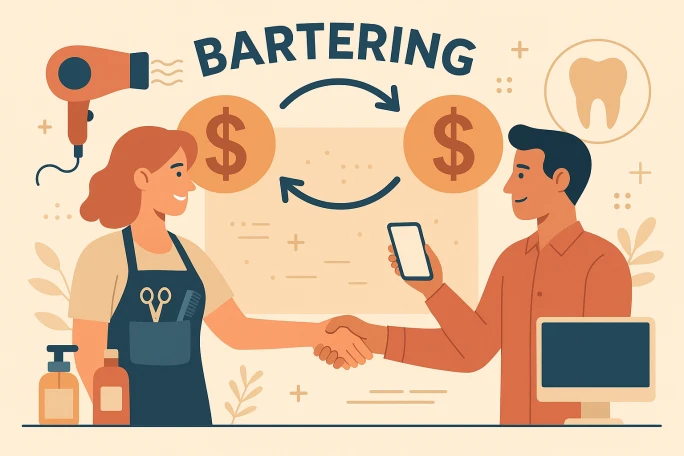
In such an atmosphere, when salon businesses (and individuals) have to stretch every dollar, bartering can be a strategic tool for saving cash while acquiring necessary resources without spending capital. Hair salons remain one of the top categories in barter requests.
In addition to hair services, advertising, public relations, website development and social media curation are popular in barter. In addition, people offer and seek services such as child care, home repair, landscaping and computer repair, not to mention professional services of dentists, optometrists, CPA’s and attorneys. Restaurants and hotels are often interested in barter to fill empty tables and guest rooms with customers they may not otherwise attract.
In this digital age, it’s possible to find bartering partners across the city or across the country. Through third-party barter exchanges—where members pay a commission for goods or services traded—more complex trades are possible. These digital capabilities are one of the factors that are driving the resurgence in bartering.
Here’s how a barter exchange works:
A business lists a product or service for trade through a barter exchange, most of which operate regionally. When someone barters for those goods and services, the business receives a trade credit, or “barter dollars,” based on the dollar value of the good or service offered. It can then use those trade credits to “purchase” goods or services offered by other members.
As a result, small businesses and sole proprietorships, as well as large corporations, can use these channels to market to new customers and build a valuable network. The barter exchanges offer arbitration in the case of a dispute, and they keep track of the bookkeeping and the transactions must be reported to the IRS. Barter is a marketing and cash management tool, not a tax tool.
Bartering turns your downtime into valuable commodities, but it shouldn’t form the basis of a business. Barter should only be 3% to 5% of a business’s annual revenue; therefore, a business owner shouldn’t spend more than a couple of hours a week on these ventures.
Ad Loading...
Relationship + Community Building Benefits of Bartering
There are two more reasons to consider adding barter to your financial portfolio. They are less concrete but just as important.
Bartering encourages sustainability through the repurposing of goods and services, supporting the so-called “circular economy.” It also builds relationships and encourages collaboration among individuals and business owners who may not agree on anything else. Mutual respect and trust are building blocks not only of businesses, but of our entire economic system as well.
The role of the barter model is to create new sales to offset both business and personal expenditures, thus conserving cash. This is a necessity during these trying economic times, when preserving cash is a priority.
ABOUT THE AUTHOR: John Strabley has been CEO of International Monetary Systems (IMS), one of the country’s leading third-party B2B barter exchanges, since 2011. Based in the Milwaukee area, IMS operates in more than 40 cities nationwide. Strabley holds the industry’s highest professional designation, Certified Trade Broker, and was the 2023 inductee to the Barter Hall of Fame. www.imsbarter.com, 800-559-8515.
What makes salon content worth a pause? Hairstylists Janelle Eyre, Sean Crutcher and Luis Rodriguez share how they show their work, earn guests’ trust and make posting feel manageable. You can get MORE from these artists in our upcoming webinar!
Anny VanDriel, owner of Be Rosie Salon and creator of Pricing Isn’t Personal, volunteered to share a pricing presentation to beauty school students a year ago, and ended up learning more than she expected.
From the launch of the Ulta BeautyArtist Collective to the evolution of Trendspiration, celebrating stylists is what The Salon at Ulta Beauty does best.
With more than four decades in the industry, hairdresser and MODE Education founder Stan Newton has built a career around the art and discipline of cutting hair, learning the rules so he can break them.
Beauty professionals should evaluate each service based on its popularity, profitability, and alignment with current trends. Conducting client surveys and analyzing booking data can provide insights into which services are in demand and which might be phased out.
LifeSpa leader Ali Yanez explains why strong mentorship, predictable income, meaningful recognition and the right work environment help beauty professionals build careers that last.
Whether a beauty professional chooses a commission salon, booth rental, salon suite or salon ownership, the common thread is having more choices than ever before.
Sport Clips Haircuts will host its inaugural "Level Up Live," a first-of-its-kind virtual event that combines live haircutting education, career inspiration, product knowledge, and employment opportunities for licensed stylists and cosmetology students nationwide.
Orthopedic PT reveals three daily exercises plus ergonomic advice that can help salon professionals avoid the aches and injuries caused by standing, bending and repetitive overhead work.
Salon suite pioneer Karen Kaminski argues that the next evolution of independent beauty businesses won't be defined by beautiful spaces alone, it will be driven by smarter systems that help professionals spend less time on administrative work and more time serving clients.
At a time when many LGBTQ+ people felt compelled to hide parts of themselves, Carlos Valenzuela found a career in beauty and a community that offered opportunity based on what you could do and how well you could do it.
Whether it's social media, fashion, film, art, or culture, Chaz Dean advises stylists to stay aware of what's inspiring people. Take the elements that make sense for you in these five lessons learned through a life in beauty.
For Jessica Domoney, building a successful career isn't about saying yes to every opportunity, it's about protecting your time, investing in yourself and creating an experience clients won't forget.
"The mistake people make is treating AI like a vending machine instead of a personal assistant." Digital marketing expert Scott Moon shares how beauty professionals can use AI while staying authentic