When it comes to hair color in the year 2025, every professional is a futurist. That's because the current top crop of new beauty grads will be the ones to mold the next generation. If you can't teach them to do any better than a drugstore box can, there goes the business. Guide them-from basics to new technologies-and that's a horse of another color.
Why Mentoring Works
Ad Loading...
Mentorship programs aren't just for sharing knowledge-they've proven to keep rising stars from job hopping. That's one of the reasons Greg Best, owner of G. Best Salon in Portland, Oregon and president of the International Haircolor Exchange, created a "shadowing" program for last year's IHE conference.
"The industry has an average drop-out rate of three years; there's a great need to align experienced professionals with inexperienced ones," says Best. "By pairing 28 juniors with IHE member-mentors who have a great color business, we underscored that mentoring is an important part of social networking."
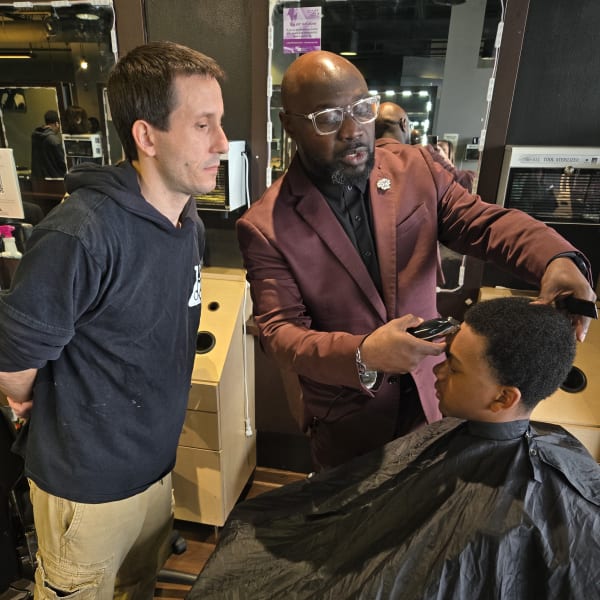
Acting as sounding boards, interpreters and encyclopedic sources, the mentors explained presentations, made professional introductions, answered lunch-time questions (from career to technical) and guided their charges through a full day's color program.
But the mentors discovered some disconnects. For instance, entry-level colorists commonly asked about becoming platform artists or show educators, yet few seemed to realize they were lacking in hair color fundamentals.
Ad Loading...
To find out more about what works in a mentoring relationship, what doesn't and what tomorrow's colorists will need most, we spoke to several IHE mentors, including Greg Best, Kim DeSoto (manager and hair color director of Spa in the Valley in Hunt Valley, Maryland), Peggy Sue Schmoldt (owner of Academy of Cosmetology Arts in Denver) and Sheila Zaricor-Wilson (owner of Master Design Inc in Memphis, Tennessee.) Here's what they had to say.
What's in a Colorist?
What makes a hair colorist great? Soft skills; passion; the desire to keep on learning; follow-through.
If you can't verbalize and be intuitive about client's desires, your work will get lost in translation, say accomplished colorists. You have to ask the right questions for a successful consultation.
Other definitions of a great colorist: Someone who truly understands color balance-the placement of color through the hair and within the head shape. And someone with good technical knowledge and application abilities, who can rely on his or her intuition.
Ad Loading...
"A person who knows how to work with both sides of their brain," summarizes Zaricor-Wilson. "To formulate color, you have to be a visionary who can foresee how to enhance complexion, skin tones and lifestyle."
0803futurecolor1
If you're training colorist wannabes, chances are they've had very little hair color education in basic school, but don't realize it. When Zaricor-Wilson asked a new graduate how long she had been coloring hair, her response was that she had done tons of color "at home" while she was in school. The wrong way of doing things was already ingrained in her work.
Breaking Down the System
To start trainees off right, stop taking basics for granted, says Zaricor-Wilson. Break down the processes that have become second nature to you and list the steps you're actually following.
"It was awesome for me to re-learn the formal process we really follow," she says. "If someone doesn't see what you see, you really have to break it down to explain what you are doing and why."
Ad Loading...
Must-Knows
What does tomorrow's colorist have to know to become a genuine pro? IHE mentors' musts-to-learn list for any colorist training program include:
• The laws of color.
• The color wheel-all it tells you and how to use the information.
• Levels, undertones and porosity. "The latter is huge, with so much multi-ethnic and sensitized hair among modern consumers," says Best. "Colorists forget how much porosity changes processing times."
Ad Loading...
• How to accept that you made a mistake.
• Knowledge of all the major hair color lines on the market. "At least know the finishes they create," says Schmoldt. "Some are translucent, others opaque or transparent." Know each product line's base and how different brands compare. Some companies have a Level 4 that most colorists would call a Level 2, notes Best.
• In-depth knowledge about lighteners beyond powder bleach.
• Specific technical information on creating reds and blondes, and covering gray.
• How to execute a precise, clean, neat application.
Ad Loading...
• An arsenal of unique techniques.
• Why the same formula doesn't work forever, when and how to change it.
• Chemical components and processes, and how far products can be pushed.
• Hair chemistry, including an understanding of the role of keratin and minerals.
• The effect of medications on hair color.
Ad Loading...
Of course, these are just for starters-the got-to-be-theres of any training program. Next comes years of experimentation and experience.
The Intangibles
Training can't always explain why a colorist chose a particular formula. While natural level, porosity, skin tone, percentage of gray and eye color all come into play, it's the intuitive part that makes for the final mix. Which brings up the question, do need creativity to be great colorist?
Says DeSoto, "You can be good without being creative but to be extraordinary, to not only correct color but offer options to corrective situations, you do need creativity."
You also need an eye. And that's where there's some disagreement. Can anyone develop an eye for true color?
Ad Loading...
Most the mentors agree that the hardest thing to teach is how to see true contributing pigment, undertones, subtle nuances and tonal values. Some say not everyone can "see" like a colorist. Best disagrees-and has good reason.
"I'm color-blind," he confesses. "My handicap made me more aware that it's our job to create the color a client sees in her mind, which is pretty difficult. Certainly, you need the desire to develop an eye, but you can do it."
Most of what a colorist can teach involves hard skills but soft skills are the primary determinate of success. What's hardest of all to teach is what our first mentors, our parents, have always fretted over: How to produce an upbeat, compassionate, flexible human being. You can provide the best example possible, but if those unselfish fundamentals don't take, a truly great colorist you can't make.
Put another way by Schmoldt, "The hardest thing for trainees to learn is that not everyone in their chair wants to look like a hairdresser."
Future Vision
Ad Loading...
What the next generation of colorists will need that their mentors didn't?
"In addition to seeing more hair types and textures than ever, colorists of the future will have to deal with different types of hair extensions, because they're here to stay," says Best. "I'm seeing more with the metal clamp attachment systems, and mixing metal and
chemicals increases the likelihood you'll have problems."
Any good colorist understands relaxers but future colorists can add Japanese thermal straighteners, texturizers of all types, Brazilian straighteners and "keratin-only" smoothing systems to the mix.
Finally, colorists must understand how to do business in a new way: on the internet, via cell phones and PDAs, and through social networking systems.
"I really got lucky with my last name," says Best. "Today, most clients come from the internet, and when they Google ‘best colorist' or ‘best hair color,' my name comes up first. Colorists opening future salons will have to think about the name in relation to search engines."
Ad Loading...
Point taken. Clearly the wrong salon name could make your business "Curl up and Dye."
Hair color by Sylvie Hendrikx and Maryline Forges, style by Michaël Del Bianco, for XYZ Belgium; photography by Eveline De Mey for BG projects; make-up by Juan Pacifico; photostyling by Tom Göbels.
What makes salon content worth a pause? Hairstylists Janelle Eyre, Sean Crutcher and Luis Rodriguez share how they show their work, earn guests’ trust and make posting feel manageable. You can get MORE from these artists in our upcoming webinar!
Anny VanDriel, owner of Be Rosie Salon and creator of Pricing Isn’t Personal, volunteered to share a pricing presentation to beauty school students a year ago, and ended up learning more than she expected.
From the launch of the Ulta BeautyArtist Collective to the evolution of Trendspiration, celebrating stylists is what The Salon at Ulta Beauty does best.
With more than four decades in the industry, hairdresser and MODE Education founder Stan Newton has built a career around the art and discipline of cutting hair, learning the rules so he can break them.
Beauty professionals should evaluate each service based on its popularity, profitability, and alignment with current trends. Conducting client surveys and analyzing booking data can provide insights into which services are in demand and which might be phased out.
LifeSpa leader Ali Yanez explains why strong mentorship, predictable income, meaningful recognition and the right work environment help beauty professionals build careers that last.
Whether a beauty professional chooses a commission salon, booth rental, salon suite or salon ownership, the common thread is having more choices than ever before.
Sport Clips Haircuts will host its inaugural "Level Up Live," a first-of-its-kind virtual event that combines live haircutting education, career inspiration, product knowledge, and employment opportunities for licensed stylists and cosmetology students nationwide.
Orthopedic PT reveals three daily exercises plus ergonomic advice that can help salon professionals avoid the aches and injuries caused by standing, bending and repetitive overhead work.
Salon suite pioneer Karen Kaminski argues that the next evolution of independent beauty businesses won't be defined by beautiful spaces alone, it will be driven by smarter systems that help professionals spend less time on administrative work and more time serving clients.
At a time when many LGBTQ+ people felt compelled to hide parts of themselves, Carlos Valenzuela found a career in beauty and a community that offered opportunity based on what you could do and how well you could do it.
Whether it's social media, fashion, film, art, or culture, Chaz Dean advises stylists to stay aware of what's inspiring people. Take the elements that make sense for you in these five lessons learned through a life in beauty.
For Jessica Domoney, building a successful career isn't about saying yes to every opportunity, it's about protecting your time, investing in yourself and creating an experience clients won't forget.
"The mistake people make is treating AI like a vending machine instead of a personal assistant." Digital marketing expert Scott Moon shares how beauty professionals can use AI while staying authentic